Categories

Showing posts with label freedom. Show all posts

Monday, October 14, 2013

ModPo 2013 #38 The Brilliant, Burning Negative Plath: On Wilbur's "Cottage Street, 1953"

Image of Sylvia Plath reported missing in 1953 from news.frrole.com.


Richard Wilbur, "Cottage Street, 1953"

Framed in her phoenix fire-screen, Edna Ward
Bends to the tray of Canton, pouring tea
For frightened Mrs. Plath; then, turning toward
The pale, slumped daughter, and my wife, and me.

Asks if we would prefer it weak or strong.
Will we have milk or lemon, she enquires?
The visit seems already strained and long.
Each in his turn, we tell her our desires.

It is my office to exemplify
The published poet in his happiness,
Thus cheering Sylvia, who has wished to die;
But half-ashamed, and impotent to bless.

I am a stupid life-guard who has found,
Swept to his shallows by the tide, a girl
Who, far from shore, has been immensely drowned,
And stares through water now with eyes of pearl.

How large is her refusal; and how slight
The genteel chat whereby we recommend
Life, of a summer afternoon, despite
The brewing dusk which hints that it may end.

And Edna Ward shall die in fifteen years,
After her eight-and-eighty summers of
Such grace and courage as permit no tears,
The thin hand reaching out, the last word love.

Outliving Sylvia who, condemned to live,
Shall study for a decade, as she must,
To state at last her brilliant negative
In poems free and helpless and unjust.


[The following note has been provided by Richard Wilbur:] "Edna Ward was Mrs. Herbert D. Ward, my wife's mother. The poet Sylvia Plath (1932-1963) was the daughter of one of Mrs. Ward's Wellesley friends. The recollection is probably composite, but it is true in essentials."

------------------------------------------------------

I've always been intrigued by Sylvia Plath. I find her more interesting than Richard Wilbur! Ha! But this was a very interesting poem. This is the poem from the "successful," stable poet eyeing the damaged (but free!) poet that was Sylvia Plath.

As mentioned in the video discussion, it's hard to tell if he was putting down the resulting poems of Plath. There is that word, "free" but right beside it are two potential negatives: "helpless," and "unjust." Helpless might be the refusal to be helped. I get that. But unjust? There was a suggestion that this might imply unjustified. In my own opinion, I think freedom (with all those costs) was worth the price.

Wilbur himself says that the "refusal," the "brilliant negative" was too large, way too large for the "slight genteel chat." I might say the same for the slight and cadenced genteel poem versus the wild wailing of "Lady Lazarus."

Wilbur talks about Edna Ward's grace and courage, privileging the long (and long suffering) life over this inexplicably drowned girl who sees life as a sentence ("condemned to live"). I can imagine the same puzzlement and helplessness that anyone might have over someone who is mentally ill. But being depressed and mentally ill is different from being the writer of poems that capture the pain of that existence.

No, Richard Wilbur, "the published poet in his happiness" and the "genteel chat" and the niceties and comforts of traditional meter and rhyme will not be enough. At least not for as great and haunted a poet as Plath.


ModPo 2013 #37 Challenging The Limits of Subject Matter: On Wilbur's "The Death of a Toad"

Image from ebeysoman.hubpages.com .


Richard Wilbur, "The Death of a Toad" (1950)

               
                  THE DEATH OF A TOAD

       A toad the power mower caught,
Chewed and clipped of a leg, with a hobbling hop has got
   To the garden verge, and sanctuaried him
   Under the cineraria leaves, in the shade
      Of the ashen and heartshaped leaves, in a dim,
          Low, and a final glade.

       The rare original heartsbleed goes,
Spends in the earthen hide, in the folds and wizenings, flows
    In the gutters of the banked and staring eyes. He lies
    As still as if he would return to stone,
        And soundlessly attending, dies
           Toward some deep monotone,

       Toward misted and ebullient seas
And cooling shores, toward lost Amphibia^Rs emperies.
    Day dwindles, drowning and at length is gone
    In the wide and antique eyes, which still appear
        To watch, across the castrate lawn,
            The haggard daylight steer.

---------------------------------------------------------

This was a funny poem. It was mentioned several times in the video discussion that this is a satire given its over-the-top rhymes and high diction for such a lowly topic as a toad. At the turn of the poem, there is also mention of a mock heroic crossing towards "Amphibia's emperies" (like the Norse gods). There was also mention of how suburbia is the perfect setting for this satire, given that suburbia itself is an artifice.

I asked the question to myself several times: what's at stake? Other than a humorous look at the death of the toad, what else could this poem be contributing? It's hard to fathom. I liked the idea of "art for art's sake" being floated in the discussion. However, it wouldn't have been humorous or satirical if it were. It would just have been a display of ability. Is it making fun of the genre the way that Bishop's poem did? Whereas Bishop spells out what he thinks of traditional poetry, is Wilbur criticizing the imagists for their freedom of subject matter? Was he implying that freedom in subject matter would result in this elevation of the toad (or the elevation of some white chickens)? Was he implying that there is a limit to "absolute freedom in the choice of subject?"

Perhaps, it's that. But he chose the traditional form to mock this freedom. One might say that they (traditional form and absolute freedom in subject matter) really don't go together/ work together.

All in all, poor toad!


Sunday, October 13, 2013

ModPo 2013 #36 Boundaries and Cycles: On Frost's "The Mending Wall"

Image of Frost on the wall from iws2.collin.edu. 


Robert Frost, "Mending Wall" 

Something there is that doesn't love a wall,
That sends the frozen-ground-swell under it,
And spills the upper boulders in the sun,
And makes gaps even two can pass abreast.
The work of hunters is another thing:
I have come after them and made repair
Where they have left not one stone on a stone,
But they would have the rabbit out of hiding,
To please the yelping dogs. The gaps I mean,
No one has seen them made or heard them made,
But at spring mending-time we find them there.
I let my neighbor know beyond the hill;
And on a day we meet to walk the line
And set the wall between us once again.
We keep the wall between us as we go.
To each the boulders that have fallen to each.
And some are loaves and some so nearly balls
We have to use a spell to make them balance:
'Stay where you are until our backs are turned!'
We wear our fingers rough with handling them.
Oh, just another kind of out-door game,
One on a side. It comes to little more:
There where it is we do not need the wall:
He is all pine and I am apple orchard.
My apple trees will never get across
And eat the cones under his pines, I tell him.
He only says, 'Good fences make good neighbors'.
Spring is the mischief in me, and I wonder
If I could put a notion in his head:
'Why do they make good neighbors? Isn't it
Where there are cows?
But here there are no cows.
Before I built a wall I'd ask to know
What I was walling in or walling out,
And to whom I was like to give offence.
Something there is that doesn't love a wall,
That wants it down.' I could say 'Elves' to him,
But it's not elves exactly, and I'd rather
He said it for himself. I see him there
Bringing a stone grasped firmly by the top
In each hand, like an old-stone savage armed.
He moves in darkness as it seems to me~
Not of woods only and the shade of trees.
He will not go behind his father's saying,
And he likes having thought of it so well
He says again, "Good fences make good neighbors."
-----------------------------------------------------------

Robert Frost has always been a favorite of mine. I've stopped by the woods of "Stopping By The Woods" and I've always been haunted by the much quoted "miles to go before I sleep." Well, first of all, I'm fascinated by snow and secondly, Frost is a master of the form. While it's been argued over and over about how the times have changed and that the form needs to follow the times, I have to tip my hat (what a strange idiomatic expression for a Filipina!) to the guy for sticking to his guns (another idiomatic expression...but perhaps one more in touch with the Philippines) and doing the most he could with the traditional form.

I appreciate his argument while I don't necessarily subscribe to it. Many, many years ago, I wrote free verse long before I was formally introduced to it in grade school. My teacher corrected my poems by making my lines rhyme! My stepmother asked to meet my teacher and she gave my teacher a piece of her mind. I can imagine my grade four self meeting Frost (one frosty evening) and petulantly asking, "But why should poems rhyme?" And I can imagine his answer, "Little miss, it's like playing tennis without a net!" Hahaha!

"Mending Wall" is a multilayered and self conscious argument for the net, for the rules, for the form. Oh! But rules are meant to be broken! He reminds me that rules must be learned before they can be broken. That I can appreciate.

I like how he makes the cause of the broken wall so mysterious: "Something there is that doesn't love a wall." And then he links this to "elves" which he also quickly dismisses. I like how that is also metapoetic and universal. It's metapoetic because he is living at a time when the "wall" of structured poetry is being broken left and right by poets he does not like (Stein, for one). It is also universal because any kind of structure is always being broken down by chaos. It's a constant struggle: order and chaos. Frost makes the argument for order but he creates the false binary of order versus chaos.

Did the speaker agree to "good fences make good neighbors"? The speaker points out that the neighbor in the poem is not aware of its significance, repeating only what he has been told. The speaker, of course, is not as dim and has thought this over. He repeats the phrase. I have no doubt the speaker is advocating this phrase. It is clear from his self-conscious choice of honoring the tradition of mending the wall. I read this on two levels. The first being, good structure makes good poets. It is in recognizing and keeping to the boundaries that the good poet, the good human being is at the height of his humanity. The second being, boundaries define human interaction. There are no human interactions if there are no boundaries. I agree on the second (more than the first) that boundaries have their role in any interaction.

There are many other facets outside the order that Frost recommends. Yes, there is a classical elegance to the form that he chooses. However, the first world war (and then the second) has left the world in such fragmentation that classical elegance no longer applies. For something to grow, it must leave its boundaries. The cell cannot be in stasis, biologically speaking.

I appreciate, too, what Frost is saying about the wall: it will always be broken. It takes a certain kind of effort to continuously mend the wall. It says something about the cyclical nature of humanity as well. There will always be a struggle to break free...but at some point, that "breaking free" will become a tradition in itself which will again be broken.

This brings me back to canon, to Pound (and criticism), and to ars poetica. Like any piece of art (which may not have been considered "art" during its time), the poem captures the scent, the shape, the image, the structure of its times. And definitely, Frost captured an aspect and an argument of ars poetica. "Mending Wall," I'm sure, was his response to imagism. I hold this up as part of the prism of poetry. It is multifaceted, multicultural and always engaging. I hope to capture as much as I can of the variety and richness of the voices I hear out of ModPo.

ModPo 2013 #35 The Sun, The Son and The Truth: On Brooks' "truth" and Knight's "The Sun Came"

Image from stickerupper.com.


truth
BY GWENDOLYN BROOKS
And if sun comes
How shall we greet him?
Shall we not dread him,
Shall we not fear him
After so lengthy a
Session with shade?

Though we have wept for him,
Though we have prayed
All through the night-years—
What if we wake one shimmering morning to
Hear the fierce hammering
Of his firm knuckles
Hard on the door?

Shall we not shudder?—
Shall we not flee
Into the shelter, the dear thick shelter
Of the familiar
Propitious haze?

Sweet is it, sweet is it
To sleep in the coolness
Of snug unawareness.

The dark hangs heavily
Over the eyes.

Gwendolyn Brooks, "truth" from Blacks. Copyright © 1987 by Gwendolyn Brooks.  Reprinted by consent of Brooks Permissions.

Source: Blacks (Third World Press, 1987)

--------------------------------------------

The Sun Came
BY ETHERIDGE KNIGHT
                                                        And if sun comes
                                                        How shall we greet him?
                                                                    —Gwen Brooks

The sun came, Miss Brooks,—
After all the night years.
He came spitting fire from his lips.
And we flipped—We goofed the whole thing.
It looks like our ears were not equipped
For the fierce hammering.

And now the Sun has gone, has bled red,
Weeping behind the hills.
Again the night shadows form.
But beneath the placid face a storm rages.
The rays of Red have pierced the deep, have struck
The core. We cannot sleep.
The shadows sing: Malcolm, Malcolm, Malcolm.
The darkness ain't like before.

The Sun came, Miss Brooks.
And we goofed the whole thing.
I think.
(Though ain't no vision visited my cell.)

Etheridge Knight, "The Sun Came" from The Essential Etheridge Knight. Copyright © 1986 by Etheridge Knight. All rights are controlled by the University of Pittsburgh Press, Pittsburgh, PA 15260.  Used by permission of University of Pittsburgh Press.

Source: The Essential Etheridge Knight (University of Pittsburgh Press, 1986)
-------------------------------------------------------

I can't read Brooks without the response of Knight. Ignorance is bliss, ignorance is paradise (just ask Adam and Eve). The truth is cruel (how can it not be with "firm knuckles/ Hard on the door?"). This is essentially what Brooks states in her poem. Knight dispels this by claiming that the truth did come, the sun did come... in the form of Malcolm X but his poem ends on a sad note, a regretful note.

Brooks' poem is in iambic pentameter, using a traditional form which Knight answers without the regularity of a traditional form but with his own musicality, like in the repeating words of: Malcolm, Malcolm, Malcolm. I appreciated the audio discussion because it pointed out the meanings of "flipped" (a betrayal) and "goofed" (foolish mistake) as prison terms, situating Knight in his cell (which he mentions in parenthesis at the end of his poem). It's ironic that Knight talks of Malcolm in messianic/ Christian terms: Sun/ Son, the sacrifice of the Sun/ Son while Malcolm was actually Islamic. Nevertheless, it was pointed out during the discussion that Knight's poem was a reflection of the mood among those in prison at the time Malcolm was assassinated. I can imagine the guilt and the regret of Malcolm's message of black pride being cut short by his death.

I try to see this poem conversation as well in terms of my experience. The truth is relative. The truth sometimes depends on who is telling the story. The truth is I come from a mixed race where nothing is truly "pure." The truth is: freedom comes with its own price. And even in the Philippines, supposedly a free country, we are still reeling from centuries of patronage and time again we have "flipped" (we were also called "flips" once, as a derogatory term, by Americans) and "goofed" with our opportunities, earning our label of the "sick man of Asia."

In our islands we have more than our fair share of an unblinking sun. And not only that, we have had centuries of "the Son." And still, the dark continually hangs heavy on our eyes. I do not doubt, though, that we will have our day for answering the hammering at our doors. We've done enough flipping and goofing among ourselves, at some point we will meet the light completely.

Monday, September 30, 2013

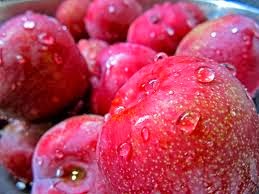
ModPo 2013 #20 Bright Sweet Moment: On Williams' "This Is Just To Say"

Image from cloudberry.wordpress.com.


This Is Just To Say

by William Carlos Williams
I have eaten 
the plums 
that were in 
the icebox 

and which 
you were probably 
saving for breakfast 

Forgive me 
they were delicious 
so sweet 
and so cold
------------------------------------

Refrigerator magnet poetry. Honestly, what's wrong with that? It makes poetry an exercise for everyone. Isn't it a play of words and a conversation that is out of the ordinary? Another observation: this poem is very interesting because it's not a straight-out imagist poem. There is a bit of tension going on between the speaker and the reader who is addressed (the "you" in the poem). There is a fake apology that ends the poem that leaves a lot going on in the reader's imagination. 

First, I want to address turning a refrigerator message into a poem. I think it was timely. It captures the America of 1920 that was benefiting from ice boxes. It captures that a kind of marriage existed during that time. The imagist manifesto element that speaks into this poem is the absolute freedom to choose the subject matter. There is nothing too everyday, too quotidian to pick as a subject of the poem. It certainly isn't universal. That's what makes it so interesting. 

There is something interesting going on in the power play of the sexes in the poem. Was this a happy marriage? There is a levity in the fake apology. It is a kind of levity that only someone who is pretending to apologize would actually say in a note. I see a wide margin of "forgiveness" there. 

Lastly, like the poem, "Between Walls," I think this is a celebration of a little bright moment in the speaker's life. The sweet cold plums are ordinary things that can be taken for granted. But not in this poem. It is a moment of pure, unapologetic enjoyment and, if only for that, it is a glimpse of beauty in the suburban home. 

Friday, August 30, 2013

Habagat


for Clea

by Justine C. Tajonera

We escaped the storm in Manila by a day.
The skies were overcast for days at the beach.
While we walked the length of Station 1 and 2,
I watched the perfect curve of your cheek, the
way a bikini, which I've dreaded my whole life, was
nothing to you. Around you, the time has come. Pork
barrels are rolling open like so many mouths with lolling
tongues, the streets at home are filling up with murky
water, the seas are heating up like a potent
soup. By the time we come back to Manila,
the people will have taken to the streets.
I want you to keep running unhampered in the sand.
I want you to be cheeky and defiant, the way
you are now as you hold up that stick in your hands.
I want you to kick up the dust and say
want you want. All I wish for are at least
a few seasons of amihan to hold up the tumult
that you are. All I wish for are a few quiet
summers for you, for your children, when there
are no crippling droughts, no floods,
in the coming months, to survive.

Boracay, August 18, 2013

Monday, April 11, 2011

The Hermit

by Justine C. Tajonera

I met a hermit at the peak
of a mountain
who had given up
the world
and all its concerns.
He was past the need
for survival
and the accumulation
of coin.
He was past the need
for leaving
legacies
for his children.
He spoke with the mountain
and the mountain
spoke with him.
He told me that
he gave up
so much
to know the
simplicity
of freedom.

I am the hermit.
You are
the hermit.
Perhaps,
not in
this life.

Image from

Photo credit : (cc-by-nc-nd) Bruno Monginoux / www.Landscape-Photo.net : nature and urban photography, free stock photos 

Thursday, May 13, 2010

EDSA 1986


by Justine C. Tajonera

"Lo, all our pomp of yesterday
Is one with Nineveh and Tyre!
Judge of the Nations, spare us yet,
Lest we forget--lest we forget!"

 - Rudyard Kipling, Recessional

1986 was the year my youngest
brother was born.
1986 was the year I was in
fifth grade.
1986 was the year
that a dictatorship ended.
1986 was the year
I witnessed a miracle
of nationhood.

There was a silence
in the streets of Cebu
when we listened to the
radio and heard of tanks
forging through EDSA
and the people
who met them
with flowers
in their hands.

On that day, the opposition's
presidential candidate,
the widow of
a slain hero,
was praying with
the Carmelite
nuns
in our city.

We were at home
praying the rosary,
wondering incredulously
at what had
transpired
so far.

Then there was
a miracle.
No blood
was shed
and the dictator
and his family
flew off
in a helicopter
headed to
Hawaii.

A surge of triumph
wove its way
through the
city.
We joined the people
on the streets
dancing, shouting,
waving yellow
ribbons
in the air.

Rich and poor,
young and old
converged
with relief and a
palpable sense
of unity.

I write this
lest I
forget.

I write this for
you.
One day,
this will be a dry
lesson
in history.
But let me tell you
as if it happened
only
yesterday.

It was possible.
And it still is.
Lest we forget. 

For the Filipino children
(March 13, 2010)
On the cusp of a new government

Image from http://www.flickr.com/photos/layamaria/3613071550/

Thursday, March 25, 2010

Crossing The Street


by Justine C. Tajonera

We cross the street
together
and you do not
hesitate,
your trust is
absolute.

My hand is steady
as well,
certain and unwavering
as my love
for you.

But as we reach
the other side,
I wonder what gifts
await your generation.
The tainted air
you breathe
is hardly any parent's
dream of
legacy.

But we are alive
together,
now,

walking home,
free to dream
a world
into being.

(March 25, 2010)
Image from http://www.flickr.com/photos/steverhode/3545022225/

Wednesday, March 03, 2010

The Trap

By Justine C. Tajonera

Freedom is a fearful
thing:
unlimited options,
the burden of
choice.

I take for granted
that my world
has been paid
for lifetimes
ago.

And a life by default
is as tempting as
sin.

There is a comfortable
trap wrapped around
me and I would be mad
to let it go.

But then I would
be truly free.

March 3, 2010

Thursday, February 18, 2010

Freedom


by Justine C. Tajonera

What does real freedom
look like?
I peer behind the bars of
the a work day's hours
and glimpse some vague
kind of heaven
made up of
ocean vistas and wide
spaces of
time.

Or isn't it being free
to love
you?

When I open up and
sweep away
all constraints:
I will still take this pen
and write these
words,
I will still go to great
lengths
to give, to create,
to tear at the boundaries
and find new
struggles
worthy of
my life.

And I would still
love
you.

(Feb. 18, 2010)
Image from http://www.flickr.com/photos/phae/426425321/in/set-72157600002381973/

Tuesday, February 02, 2010

Generosity


by Justine C. Tajonera

This embrace has no limits.
It has nothing to do with depletion,
with the weary resignation
of giving away too
much.

For something so essential
there is no measure,
no moment of having had
enough. 

Go fearlessly into
the heart of the matter
and see what is really
needed.

It hardly has to do with
the amount of things,
the weight of things,
the number.

For grief and joy,
comfort and
love
are hardly grasped
by limits,
but they are all
completely
absorbed and
conveyed
in a touch.

(February 2, 2010)
Image from http://picasaweb.google.com/lh/photo/XzPziB_BzTzbxSc1BlxwaQ

Monday, January 11, 2010

The Oracle

By Justine C. Tajonera


Know thyself:
it is inscribed at the entrance
of an ancient
temple in Greece.


Know your limits
and your
freedoms.


Know the lies you have told
and the thruths
you have
declared.


Know your body,
your mind,
your heart
and your
soul.


Know your strengths
and your weaknesses.


Know your words
and the thoughts
in your head.


Know that what you
remember
and what you forget
make up the life
that you love
or
regret.

The clarity of
the image that
you sculpt,
this life of yours,
is of your own
making.

Know it,
the oracle
says.

(Jan. 10, 2010)


Image from http://www.flickr.com/photos/chrisjohnbeckett/566457587/

Marble relief: Achilles consulting the Oracle of Delphi, and Achilles healing Telephus with his spear (Herculaneum)

Monday, January 04, 2010

Pink Donut

by Justine C. Tajonera

Nothing tastes as good as
the color on this donut.
His choice overrides everything:
the taste of the donut,
the place where we buy it.
Nothing matters except that
he chooses a pink one.
Few have the privilege
of an obstinate choice,
a dedication so pure,
so free.

No one will understand
this but us,
his bewildered,
adoring parents.
The chaotic universe
looms large
in the background
but we are safe
together
gathered around
our son's
pink
donut.

(Jan. 3, 2010)

Image from http://www.flickr.com/photos/7310714@N06/3741991820

Sunday, December 06, 2009

The Constraints Of Time


The hands of
the clock
move relentlessly
to the
right,
indifferent to
my state of
mind,
my appeals for
two more
minutes.

However,
the constraints
of time
are largely
imaginary.

Beyond
this moment
a great chasm
divides me
from the past
and the future
is veiled with
uncertainty.

It is either paralysis
or freedom
now.

So I hand my son's
toothbrush
to my husband,
mindful of my
son's teeth
tonight
and kiss them
both
good night.

(Dec. 5, 2009)

Friday, November 13, 2009

A Place To Stand

by Justine C. Tajonera

I imagine that this piece of earth
where I have planted my feet
holds me up because
of my will.

I imagine that there
will never be a day
that I can say
someone else
is the root
of all
ills.

I imagine that no one
has any right to my
freedom, my dreams, my
choices.

I imagine that there will
never be
any pity
for me.

I imagine that this world
is falling apart at the seams
because I have not
sewn it properly
together.

I open my eyes,
frightened,
but believing.

(Nov. 13, 2009)

Sunday, November 01, 2009

Being

by Justine C. Tajonera

There is no due date
for being,
it is breathing
now,
this moment
when the air
will remain
the same.
It is this moment
when you can confront
yourself for any
unhappiness
or fear
or resignation
and open the
windows
to your own
freedom.
There is no prison cell,
there is no cage.
There is only you
holding the only
key
to your
existence.

(Oct. 29, 2009)


Image from avenueconsulting.co.uk

Search This Blog