Categories

Showing posts with label sea poppies. Show all posts

Monday, November 18, 2013

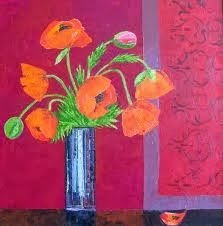
ModPo 2013 #71 All is Artifice: On Scappettone's "Vase Poppies"

Image from russell-gallery.com

Vase Poppies
BY JENNIFER SCAPPETTONE

Lavenderish dusk
strapped for stays,
pomegranates under the rubberband
chucked for a glass Oz,

letdown
splayed by the pillar-shelves
to page upon the Ottoman:

his talk has wrought suit
amid citrus gapes
and pall dunked in the bowl
and grated sage
or cleaved clear paleo-pines.

Postgeist, upcast
California upon weed,
what banker yields
so fragrant a cant
as this vagrant cant?

Information from PoetryFoundation.org: Jennifer Scappettone, “Vase Poppies” from an unpublished manuscript. Copyright © 2010 by Jennifer Scappettone. Reprinted by permission of Jennifer Scappettone.

Source: Unpublished (2010)
----------------------------------------

I found it interesting that Scappettone had to explain that, depending on your class, you pronounce vase differently. I thought that it hinted at the differences between the natural and outdoor quality of H.D.'s "Sea Poppies" and the artificial and indoor quality of "Vase Poppies." And I also caught a tone of disdain for the pretentious "other" pronunciation which she did not use in her reading.

Everything about "Sea Poppies" talks about the virtues of being hardy and out in the harsh conditions of nature. Whereas "Vase Poppies" talks about everything artificial and contrived and urbane. I really did catch the whiff of subject mockery in Scappettone's poem (whereas in H.D.'s poem, it is all praise for the subject).

I was a bit confused. Was Scappettone a) paying an homage to H.D., b) ironizing H.D., c) outright mocking the imagist process?

I appreciated the attempt to find out in the video discussion, although, it seemed to me that even the discussion did not come to a conclusion on this. However, what I did get was that "you can't say it that way anymore." There is always a call to "make it new" in language which Scappettone attempted in her poem.

If I were to follow the pattern in ModPo, it would be to focus on the form and not just on the content. Did Scappettone deliver the message in the medium? She successfully used H.D.'s very form and turned her own poem into the exact opposite of H.D.'s. What is she ultimately saying? I believe it is: All is artifice. Better get used to it, baby.

Thursday, September 26, 2013

ModPo 2013 #15 Glaucium Fimbrelligerum and new concepts of beauty: On Doolittle's Sea Poppies

Glaucium Fimbrillegerum image from biolib.de (creative commons). 


Sea Poppies

BY H. D.
Amber husk
fluted with gold,
fruit on the sand
marked with a rich grain,

treasure
spilled near the shrub-pines
to bleach on the boulders:

your stalk has caught root
among wet pebbles
and drift flung by the sea
and grated shells
and split conch-shells.

Beautiful, wide-spread,
fire upon leaf,
what meadow yields
so fragrant a leaf
as your bright leaf?
________________________

I was wondering why we were taking up two very similar poems (Sea Rose and Sea Poppies) and I was struck by the question in the video discussion about whether "Sea Poppies" is an instance in a movement working out a program, a formula of sorts? And was it possible to remove valuation/ interpretation from language?

"Language that is hard and clear" (from the imagist manifesto) goes against the nature of language. While specificity is needed in some language, language in itself is a powerful and living thing. It is a frame and it requires at least two participants for it to exist.

I think the imagist movement doesn't eliminate valuation or interpretation (while it attempts to) but it does succeeds in defining  new aesthetic. It points to new possibilities, new symbols of what could be beautiful and not what is conventionally beautiful. That in itself is a great breakthrough. But yes, I agree, it is overly ambitious to aspire for a transparent language (if there even is such a thing).

I go back to one of my favorite poems, "Ars Poetica", by Archibald MacLeish. "A poem should be equal to:/ Not true." While MacLeish is known to be a Modernist poet, his "manifesto" on poetry touches on the imagist "hard and clear, never blurred or indefinite." I don't think it means the same thing, though. MacLeish talks about presenting what is without confusing it with "truth" while the imagist manifesto of producing poetry that is "hard and clear" which could mean presenting "what is" using the most economic means and using "particulars exactly and not deal in vague generalities." "Equal to" doesn't demand the elimination of blurriness or the indefinite. It just deals with what is before the poet. It might be an image.

Ultimately, poetry is a conversation. I like the new avenues of conversation that the imagists bring but I am excited to explore how the conversation has evolved over time.

Note: I am currently taking a course on Coursera.org called Modern and Contemporary American Poetry taught by Al Filreis of the University of Pennsylvania. I will be posting my thoughts on the course discussions here.

Search This Blog