Categories

Showing posts with label william carlos williams. Show all posts

Saturday, November 09, 2013

ModPo 2013 Assignment #2:Robbed: On Williams' "Young Woman at a Window"


Instructions:

Your job in this short essay is to look closely at the poems and to argue that interpretative position - that version 2 is "more imagist." You should do so by showing how version 2 follows the manifesto but you can also do so by showing how version 1 does not.

Essay:

The second version of Williams' poem, "Young Woman at a Window," is more faithful to the Imagist Manifesto and I'll be discussing each point of the manifesto and how the second poem fulfills each point.

The first point talks about "using the language of common speech but to employ the exact word, not the nearly-exact, nor the merely decorative word." Both poems are actually sparse already and both employ the language of common speech. However, the first poem uses words that are not "exact" because they are interpretive rather than descriptive. "This little child/ who robs her/ knows nothing/ of his theft" are conclusions that can only be made due to the interpretation of the speaker in the poem. Thus, these are not "exact words" but rather nearly-exact. Also, I noticed that "this little child" was further reduced to "child" removing anything superfluous. "Child" already suffices without needing to add "this" and "little."

The second point talks about the individuality of the poet being better expressed in free verse rather than conventional forms. While the first poem is in free verse, there is a playful juxtaposition of robs and rubs, two like-sounding words that begin with the same consonant and ends with the same consonant but have different meanings. One could call it a pun, two similar-sounding words used for intended humorous or rhetorical effect, thus employing a "conventional form."

The third point talks about "absolute freedom in choice of subject." Here, I cannot see how the second is more imagist than the first simply because they both have the same subject.

The fourth point talks about "presenting an image." There shouldn't be any "vague generalities" and the manifesto rejects the "cosmic poet" or one who deals with something inconceivably vast. One manifestation of this might be the omnipresent speaker. The speaker in the first poem identifies how the mother has been "robbed" by her child. This is strictly outside of the image and is an internalization, a judgment made by the speaker in the poem. Thus, it is less imagist than the second version of the poem where the speaker's judgment is not heard.

The fifth point talks about "hard and clear" poetry, one that isn't "blurred or indefinite." For me, this means: present the subject as it is not as how the speaker sees the subject. I see it as an attempt very similar to journalistic objectivity: don't color the facts. But as I brought up in the first and fourth point, there is a "blurred" and "indefinite" statement regarding a "robbing." One cannot be sure if the child has indeed robbed the young woman. It is subjective and, therefore, not hard and clear.

Lastly, the sixth point talks about "concentration" as the "very essence of poetry." By sheer word count alone, the second poem far outstrips the first, thus adhering more closely to the Imagist Manifesto.

Personally, I prefer the first version of the poem to the second, though. The imagist manifesto has the impossible task of presenting an uneditorialized picture of the subject, a hard, clear image. However, language itself has many gaps. An "exact" word, while ideal in the imagist manifesto, still leads to some interpretation. Exactness implies only one interpretation. While both poems draw the reader in, it is the first poem that interests me...in Cid Corman's words in his poem "It isnt for want," it "detains" me. While I like the particularity of the imagist poem, I want a point for conversation. The word "robs" in the first poem starts that conversation for me. I could ask it of the imagist movement as well: Does the imagist movement rob poetry of the richness of polyvalence?

Saturday, October 26, 2013

ModPo 2013 #46 Forgive My Chopped Plums: On Koch's "Variations on a Theme by William Carlos Williams"

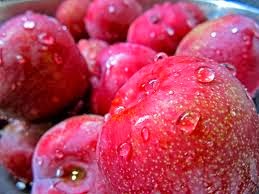
Image of chopped plums from undomestikated.blogspot.com.
Kenneth Koch, "Variations on a Theme by William Carlos Williams"

1
I chopped down the house that you had been saving to live in next summer.
I am sorry, but it was morning, and I had nothing to do
and its wooden beams were so inviting.

2
We laughed at the hollyhocks together
and then I sprayed them with lye.
Forgive me. I simply do not know what I am doing.

3
I gave away the money that you had been saving to live on for the next ten years.
The man who asked for it was shabby
and the firm March wind on the porch was so juicy and cold.

4
Last evening we went dancing and I broke your leg.
Forgive me. I was clumsy and
I wanted you here in the wards, where I am the doctor!

-------------------------------------------------------------------

This Is Just To Say
by William Carlos Williams

I have eaten
the plums
that were in
the icebox

and which
you were probably
saving
for breakfast

Forgive me
they were delicious
so sweet
and so cold
-----------------------------

"The Rape of Williams" was mentioned in the video discussion. And of course, that was all in jest, just like Kenneth Koch's poem which looks lightheartedly at the refrigerator note poem of Williams which takes itself too seriously.

As mentioned in the discussion on Williams' poem, there is a faux apology in "This Is Just To Say." Now, what would happen if we take that faux apology to extremes? The result would be the ridiculously funny poem by Koch.

He takes the Williams formula of:

  1. I did something dastardly 
  2. I did it knowing that it meant something to you
  3. Forgive me/ I'm sorry (but not really)
  4. The dastardly thing I did was so tempting to do

And he makes four variations of it, each one just as or more ridiculous than the previous one, emphasizing the unapologetic tone of the apology note. Stanza 1 goes through the entire formula. Stanza 2 inverts #2 and #1, goes through #3 and does not justify his act, skipping #4, and simply saying he didn't know what he was doing. Stanza 3 goes through #1, #2 and totally skips #3. He goes into #4 but in such a way that you can't even connect it anymore to #1, the dastardly act, since it's the March wind that's so firm, juicy and cold and not the act of giving away the money. Stanza 4 goes through #1, totally skips #2, goes through #3 and #4 (emphasis on #4 with the "you" as the temptation itself).

It was fun to go over the four stanzas and to recognize Koch's cheek in comparing himself with a legendary poet.

Forgive My Chopped Plums

1
I chopped down your plum, the one you congratulated yourself on.
Forgive me. It's almost ten o'clock.
And your lines look so inviting.

2
We laughed at Williams together.
And then I wrote this mocking plum.
Forgive me. I dreamt I knew what I was doing.

3
I gave away your plums for free, the ones that are under your copyright
for fifty years after your death. The Internet is just so delicious
and sweet and cold.

4
Last evening I danced to your lyrics and broke down
your plums. I was clumsy and I wanted you here
in my blog where I am the writer!
----------------------------------------------------

There...just joining the fray....since nothing is sacred anyway.

Monday, September 30, 2013

ModPo 2013 #22 Raging Against The Metaphor: On Williams' "Portrait of a Lady"

Image from ramp.ie.

William Carlos Williams, "Portrait of a Lady" (first published in the Dial, August 1920)

Your thighs are appletrees 
whose blossoms touch the sky. 
Which sky? The sky where Watteau hung 
a lady's slipper. Your knees 
are a southern breeze -- or 
a gust of snow. Agh! what 
sort of man was Fragonard? 
-- As if that answered 
anything. -- Ah, yes. Below 
the knees, since the tune 
drops that way, it is 
one of those white summer days, 
the tall grass of your ankles 
flickers upon the shore -- 
Which shore? -- 
the sand clings to my lips -- 
Which shore? Agh, petals maybe. How 
should I know? 
Which shore? Which shore? 
-- the petals from some hidden appletree -- Which shore? 
I said petals from an appletree. 
------------------------------------------

I really like this poem. Could it be a feminist poem? Maybe. I can definitely hear a voice protesting against a portrait being painted. It's really silly: on the one hand, there is a speaker comparing the object's thighs to appletrees, clearly hinting at "blossoms in the heavens" (could it be a peek up her skirt?), on the other hand there is another voice that refuses to be reduced into metaphors. One could easily suspect that the other voice is the voice of the "object." While one speaker has moved on to petals, abandoning the sand and shore metaphors, the other voice is repeating (one suspects, angrily) the question: which shore? Which (f***ing) shore? 

I like how Williams has left the process in, signalling the end of the metaphor (well, not the end, maybe the obsoleteness of the metaphor). Clearly it is not enough anymore to say "your breasts are twin fawns." Metaphors are powerfully loaded and assuming. The second speaker in the poem calls attention to these assumptions: "Don't take this in lock, stock and barrel. Do not be reduced. Question these questionable metaphors!"

In the end, though, I remember that even if we rage against the inadequacies of language...it is the reality in which we find ourselves. There is no reality for us human beings unless they are in language. It is how we operate. I appreciate Williams pointing at the boundaries. However, I remember that the boundary is not a boundary without a body supporting the edges. The self-awareness in Williams' poem is refreshing and I appreciate it against a backdrop of a rich history of poetry. 

ModPo 2013 #22 The Inescapability of the Rose: On Williams' "The Rose Is Obsolete"


Image from frimminjimbits.blogspot.com.


William Carlos Williams
from Spring and All (1923): "The rose is obsolete..."

The rose is obsolete
but each petal ends in
an edge, the double facet
cementing the grooved
columns of air--The edge
cuts without cutting
meets--nothing--renews
itself in metal or porcelain--

whither? It ends--

But if it ends
the start is begun
so that to engage roses
becomes a geometry--

Sharper, neater, more cutting
figured in majolica--
the broken plate
glazed with a rose

Somewhere the sense
makes copper roses
steel roses--

The rose carried weight of love
but love is at an end--of roses

It is at the edge of the
petal that love waits

Crisp, worked to defeat
laboredness--fragile
plucked, moist, half-raised
cold, precise, touching

What

The place between the petal's
edge and the

From the petal's edge a line starts
that being of steel
infinitely fine, infinitely
rigid penetrates
the Milky Way
without contact--lifting
from it--neither hanging
nor pushing--

The fragility of the flower
unbruised
penetrates space

---------------------------------------

What struck me about this poem was the inescapability of the rose. To make something new is to acknowledge the old. Power always has two sides and one cannot do without the other.

I appreciate the effort that Williams puts into redefining the rose. He goes as far as making the poem incomplete to highlight the process that the speaker is going through. He leaves fragments gaping in between lines: a "What" that has no punctuation. It could be a question or it could be pointing to the answer. And then there is the sentence that leaves a blank.."and the." Is he waiting for the reader to fill in that blank? We might have a reader that will be thoroughly confused as well. In an unguided environment, would a reader be able to access this poem and come away with something valuable? For me, as a reader who had not yet encountered the video discussion, I saw many moments in the poem that gave pause, like: "The fragility of the flower/ unbruised/ penetrates space." Isn't that power? If there is nothing that makes the flower fragile, what is it left with? Is it infinity? What a beautiful last three lines!

Once we remove the baggage of beauty and love from an object that was once imbued with it: do we remove its power? Do we give it new power? Or was that all a fiction, anyway? A fiction that we all agreed upon? Is this also a meta-poetic poem about the fiction of poetry itself?

Well, one thing is for sure: we are not done with the rose. Just as we can never be done with the game of language.

ModPo 2013 #21 What Poetry Depends Upon: On Williams' "The Red Wheel Barrow"

Image from
girlsjustwannareadbooks.blogspot.com.


The Red Wheelbarrow

by William Carlos Williams 

so much depends 
upon 

a red wheel 
barrow 

glazed with rain 
water 

beside the white 
chickens.
------------------------------------

Once again, I'm glad to have watched the video discussion. So much depends upon the phrase "So much depends/ upon!" I would have totally missed it!

I loved how the image itself became dependent on the awareness of making something new, the meta-poetic. It could easily have stood as a crisp imagist poem but the first two lines draw attention to themselves. Are they superfluous? Why does so much depend upon a red wheel barrow? So much of art depends upon something, the lenses that detect the picture, the artist from whose perspective we see the red wheel barrow. 

This brings me to the beauty of language. There is never really just one way to look at things. As Wallace Stevens points out: there are at least thirteen ways to see a blackbird. A red wheel barrow is not just a red wheel barrow, not just the one glazed with rain water contrasted beside the white chickens. So much depends on the speaker, so much depends on the reader. The red wheel barrow is the pastoral life. The red wheel barrow is what is left of the pastoral life. The red wheel barrow shines with rain water because the rain water makes all things new. The red wheel barrow is the speaker and the reader. Or the reader and the speaker are the white chickens. And without the red wheel barrow the speaker and reader do not come into view. 

It's amazing how much can come out of a few photographic lines. Poetry depends upon traditions and innovations.  It makes me want to review all my poems and see how innovative I have been or how inarticulate or unaware I really am about the sources of my poetry. 

ModPo 2013 #20 Bright Sweet Moment: On Williams' "This Is Just To Say"

Image from cloudberry.wordpress.com.


This Is Just To Say

by William Carlos Williams
I have eaten 
the plums 
that were in 
the icebox 

and which 
you were probably 
saving for breakfast 

Forgive me 
they were delicious 
so sweet 
and so cold
------------------------------------

Refrigerator magnet poetry. Honestly, what's wrong with that? It makes poetry an exercise for everyone. Isn't it a play of words and a conversation that is out of the ordinary? Another observation: this poem is very interesting because it's not a straight-out imagist poem. There is a bit of tension going on between the speaker and the reader who is addressed (the "you" in the poem). There is a fake apology that ends the poem that leaves a lot going on in the reader's imagination. 

First, I want to address turning a refrigerator message into a poem. I think it was timely. It captures the America of 1920 that was benefiting from ice boxes. It captures that a kind of marriage existed during that time. The imagist manifesto element that speaks into this poem is the absolute freedom to choose the subject matter. There is nothing too everyday, too quotidian to pick as a subject of the poem. It certainly isn't universal. That's what makes it so interesting. 

There is something interesting going on in the power play of the sexes in the poem. Was this a happy marriage? There is a levity in the fake apology. It is a kind of levity that only someone who is pretending to apologize would actually say in a note. I see a wide margin of "forgiveness" there. 

Lastly, like the poem, "Between Walls," I think this is a celebration of a little bright moment in the speaker's life. The sweet cold plums are ordinary things that can be taken for granted. But not in this poem. It is a moment of pure, unapologetic enjoyment and, if only for that, it is a glimpse of beauty in the suburban home. 

Sunday, September 29, 2013

ModPo 2013 #20 Beauty in the Broken: On Williams' "Between Walls"

Image from www.123rf.com.


Between Walls

the back wings
of the

hospital where
nothing

will grow lie
cinders

In which shine
the broken

pieces of a green
bottle

- William Carlos Williams

-----------------------------------

Finding beauty in what is broken is really a modernist impulse. You won't really find it in traditional poetry. I find in the repeated mention of broken glass in Williams' poems an attempt to really flesh out this image of brokenness. One could read it as that: something is simply broken. But he imbues it with the color of growth, with the color of spring. In this poem, the broken green glass is the only thing that shines. 

I can almost imagine Dr. Williams leaning over the balcony of the back wings of the hospital looking for something to pin his focus on. He is looking for his focal point of meditation. And there, among the cinders, something mimics the stars. It is only a broken green bottle but it is a revelation. It is a moment of epiphany. 

This takes me back to my ars poetica. Poetry is a conversation but it is also a shared glimpse into something. It may be something new. It may be something beautiful. It is a view that prompts the writer to take the reader's hand. "Come, look!" the writer says. It will be worth it. No need to look up at the stars. It reminds me of Stevens' line on the thin men of Haddam. Do you not see what is at your feet? Stay grounded, here, between the hospital walls. Look down at the ground and find among the ashes what shines. It is an invitation to find in the ordinary, in the mundane, in the dullness, even in the ugliness...a brilliant moment to keep. 

ModPo 2013 #19 Breaking Glass: On Williams' "Lines"

Illustration by me.


William Carlos Williams, "Lines" (1921)

Leaves are graygreen,
the glass broken, bright green.

-------------------------------

Like the poem discussion I watched before it (Pound's "In a Station of the Metro"), WCW's "Lines" is just two lines. Without that video, I wouldn't have seen the significance of the two different types of green (how imbued with meaning!) and also how that comma literally breaks breaks the second line. Also, I would have totally missed out on the organic/ the natural vs. the inorganic/ the manufactured and the significance of the title as a statement on the aesthetic of poetry.

Similar to his other poems, I would have wondered how this was a poem in the first place. Did this poem come with effort at all? Was the sparseness really intentional? For 1921, this was the new aesthetic. This was the revolution.

I see it as a "flipping off" of Walt Whitman, directly addressing the 52-canto "Song of Myself" strewn with leaves of grass with only two lines. Those leaves are graygreen. Here I am breaking the glass. Now this is a poem.

I find myself wondering if I have paid the price as a poet. Have I gone from the beginning to today with full consciousness of how poetry has evolved? Did Willimas, too, pay that price? Is there a price to pay after all? I feel like I'm in a museum looking at a piece, perhaps at this exact piece, wondering about the graygreen grass juxtaposed with this broken bottle that is bright green. Is this art? Did I understand what was going on? Would I understand it without that whole tradition which led to this breaking of tradition?

Well, for me at least, there is a price to pay. Having the position of humility and learning is, I think, the best route to take. Give me more!

Wednesday, September 18, 2013

ModPo 2013 #7 The Lonely, Happy Genius and The Sleepers: How Williams is Whitmanian and Dickinsonian in his poem, "Danse Russe"

Image from Jacket2.org.

Note: I am currently taking a course on Coursera.org called Modern and Contemporary American Poetry taught by Al Filreis of the University of Pennsylvania. I will be posting my thoughts on the course discussions here.

I see three distinct divisions in the poem: 1) the series of "ifs" which mention the sleepers, 2) the description of the persona in his room dancing grotesquely before his mirror, celebrating his loneliness (and admiring his naked body) behind yellow drawn shades and then 3) a new stanza which deals entirely with the "then" that addresses the "ifs": (Then) who shall say I am not/ the happy genius of my household?

I see, here, a story of the only one awake in his household. "Genius" in the sense of creative power is related to the persona being free, being creative and also being lonely in this freedom and creativity. He does not mind being lonely, saying "I am best so."

It is interesting that he does not deal with this distinction as a full boast...but rather as a conditional question. It is a slanted boast. It is even a defensive boast. He is dealing with an accusation that has not even been dealt yet. He courts this judgment by describing his dance as "grotesque." He puts this scene in the reader's face daring the reader to go ahead and be disgusted. I like how WCW engages the reader with the question and with his provocative description of what he is doing behind closed doors.

WCW celebrates his creativity, his body in a very Whitmanian way but he (in this poem) also has a very Dickinsonian view of creativity: it is lonely, it is powerful enough to be stimulated even in a room (with drawn shades) in the suburbs, and it is being awake in an environment of sleepers.

Tuesday, September 17, 2013

ModPo 2013 #6 Choice and Desire: On Williams' "Smell!"

Nose illustration from gutenberg.org.


Note: I am currently taking a course on Coursera.org called Modern and Contemporary American Poetry taught by Al Filreis of the University of Pennsylvania. I will be posting my thoughts on the course discussions here.

Smell!
by William Carlos Williams

Oh strong-ridged and deeply hollowed
nose of mine! what will you not be smelling?
What tactless asses we are, you and I, boney nose,
always indiscriminate, always unashamed,
and now it is the souring flowers of the bedraggled
poplars: a festering pulp on the wet earth
beneath them. With what deep thirst
we quicken our desires
to that rank odor of a passing springtime!
Can you not be decent? Can you not reserve your ardors
for something less unlovely? What girl will care
for us, do you think, if we continue in these ways?
Must you taste everything? Must you know everything?
Must you have a part in everything?

--------------------------------------

I like how there are two layers in the poem: the literal nose and the "boney" appendage that seems to lead some men. Both are preoccupied with indiscriminate desire, both do not filter.

But I'd like to dwell on the chiding tone of Williams. In the video discussion, it treated as a false chiding. It is actually an expression of delight in the base experience. It is a guilty complicity with the "nose." And here, of course, is the connection to Whitman who celebrates the lowest, the cheapest, the closest to natural experience.

And, here, too, I bring up the theme of choice. For while the persona (through his nose) is delighting in and celebrating the smell of souring flowers, festering pulp and rank odors, he does call out the "you" and the "I" as separate. He is complicit, yes, maybe indulgent. But he does distinguish one from the other.

I like that he asks and does not merely state. While the answer could easily be "yes" to every question at the end of the poem, I remember that it is for someone to answer. The nose cannot help what it smells but it is the man who acts upon it. I am reminded, through this poem, that I am not beholden to my "nose." While desire is uncontrollable, choice is not.

The poem is a celebration of what is natural, what is innate in any creature of nature. But the division between the persona and the nose (even if the persona is highly sympathetic to the nose), by the very fact that the persona addresses the nose as separate, is also a marker between indiscriminate desire and choice.

I don't know if I'm over-reading! All in all, I thoroughly enjoyed the poem.


Search This Blog