Categories

Showing posts with label beauty. Show all posts

Tuesday, February 11, 2014

Teaching Character #1: I Totally Underrated Appreciation of Beauty and Excellence


When I looked at the list of 24 Character Strengths, I ranked Appreciation of Beauty and Excellence at #14. When I got back my VIA score, it was my #1 character strength.

That said a lot to me. It means that I have a character strength that I don't recognize as something important for my kids to have (at least as part of the top 10). When I watched the video on character strengths, I was amazed that "Love" ranked #1 among teachers and administrators (I got this as #5 in my character strengths) but ranked way below that when they were considering what character strengths their students should have.

I am led back to the idea of education as real learning...and not the output of a society that is driven by productivity (and profit, if I might add). It has to do with individuals and unique ways of seeing the world. It has to do with appreciating what is beautiful in the world and what makes myself and others happy.

I'm humbled by my own VIA score. It shows me what kind of person I am and not the person I wish I could be. My leadership strength was at #22!!! But I ranked high in gratitude, fairness, hope, and love of learning. And there's nothing wrong with that. It's a snapshot of where I am right now.

I'm very happy to have gone through this exercise. And I'm really grateful for a guide in terms of character strengths which cut across religions and politics which I can apply not just to my children's education but to my own continuing education as well.

Note: I am taking a 4-week class called Teaching Character and Creating Positive Classrooms (offered by Relay Graduate School of Education via Coursera.org) as part of my endeavors to enrich my homeschooling experience. 

Monday, September 30, 2013

ModPo 2013 #22 The Inescapability of the Rose: On Williams' "The Rose Is Obsolete"


Image from frimminjimbits.blogspot.com.


William Carlos Williams
from Spring and All (1923): "The rose is obsolete..."

The rose is obsolete
but each petal ends in
an edge, the double facet
cementing the grooved
columns of air--The edge
cuts without cutting
meets--nothing--renews
itself in metal or porcelain--

whither? It ends--

But if it ends
the start is begun
so that to engage roses
becomes a geometry--

Sharper, neater, more cutting
figured in majolica--
the broken plate
glazed with a rose

Somewhere the sense
makes copper roses
steel roses--

The rose carried weight of love
but love is at an end--of roses

It is at the edge of the
petal that love waits

Crisp, worked to defeat
laboredness--fragile
plucked, moist, half-raised
cold, precise, touching

What

The place between the petal's
edge and the

From the petal's edge a line starts
that being of steel
infinitely fine, infinitely
rigid penetrates
the Milky Way
without contact--lifting
from it--neither hanging
nor pushing--

The fragility of the flower
unbruised
penetrates space

---------------------------------------

What struck me about this poem was the inescapability of the rose. To make something new is to acknowledge the old. Power always has two sides and one cannot do without the other.

I appreciate the effort that Williams puts into redefining the rose. He goes as far as making the poem incomplete to highlight the process that the speaker is going through. He leaves fragments gaping in between lines: a "What" that has no punctuation. It could be a question or it could be pointing to the answer. And then there is the sentence that leaves a blank.."and the." Is he waiting for the reader to fill in that blank? We might have a reader that will be thoroughly confused as well. In an unguided environment, would a reader be able to access this poem and come away with something valuable? For me, as a reader who had not yet encountered the video discussion, I saw many moments in the poem that gave pause, like: "The fragility of the flower/ unbruised/ penetrates space." Isn't that power? If there is nothing that makes the flower fragile, what is it left with? Is it infinity? What a beautiful last three lines!

Once we remove the baggage of beauty and love from an object that was once imbued with it: do we remove its power? Do we give it new power? Or was that all a fiction, anyway? A fiction that we all agreed upon? Is this also a meta-poetic poem about the fiction of poetry itself?

Well, one thing is for sure: we are not done with the rose. Just as we can never be done with the game of language.

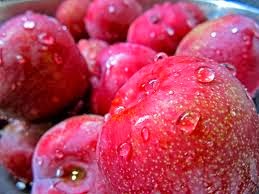
ModPo 2013 #20 Bright Sweet Moment: On Williams' "This Is Just To Say"

Image from cloudberry.wordpress.com.


This Is Just To Say

by William Carlos Williams
I have eaten 
the plums 
that were in 
the icebox 

and which 
you were probably 
saving for breakfast 

Forgive me 
they were delicious 
so sweet 
and so cold
------------------------------------

Refrigerator magnet poetry. Honestly, what's wrong with that? It makes poetry an exercise for everyone. Isn't it a play of words and a conversation that is out of the ordinary? Another observation: this poem is very interesting because it's not a straight-out imagist poem. There is a bit of tension going on between the speaker and the reader who is addressed (the "you" in the poem). There is a fake apology that ends the poem that leaves a lot going on in the reader's imagination. 

First, I want to address turning a refrigerator message into a poem. I think it was timely. It captures the America of 1920 that was benefiting from ice boxes. It captures that a kind of marriage existed during that time. The imagist manifesto element that speaks into this poem is the absolute freedom to choose the subject matter. There is nothing too everyday, too quotidian to pick as a subject of the poem. It certainly isn't universal. That's what makes it so interesting. 

There is something interesting going on in the power play of the sexes in the poem. Was this a happy marriage? There is a levity in the fake apology. It is a kind of levity that only someone who is pretending to apologize would actually say in a note. I see a wide margin of "forgiveness" there. 

Lastly, like the poem, "Between Walls," I think this is a celebration of a little bright moment in the speaker's life. The sweet cold plums are ordinary things that can be taken for granted. But not in this poem. It is a moment of pure, unapologetic enjoyment and, if only for that, it is a glimpse of beauty in the suburban home. 

Sunday, September 29, 2013

ModPo 2013 #20 Beauty in the Broken: On Williams' "Between Walls"

Image from www.123rf.com.


Between Walls

the back wings
of the

hospital where
nothing

will grow lie
cinders

In which shine
the broken

pieces of a green
bottle

- William Carlos Williams

-----------------------------------

Finding beauty in what is broken is really a modernist impulse. You won't really find it in traditional poetry. I find in the repeated mention of broken glass in Williams' poems an attempt to really flesh out this image of brokenness. One could read it as that: something is simply broken. But he imbues it with the color of growth, with the color of spring. In this poem, the broken green glass is the only thing that shines. 

I can almost imagine Dr. Williams leaning over the balcony of the back wings of the hospital looking for something to pin his focus on. He is looking for his focal point of meditation. And there, among the cinders, something mimics the stars. It is only a broken green bottle but it is a revelation. It is a moment of epiphany. 

This takes me back to my ars poetica. Poetry is a conversation but it is also a shared glimpse into something. It may be something new. It may be something beautiful. It is a view that prompts the writer to take the reader's hand. "Come, look!" the writer says. It will be worth it. No need to look up at the stars. It reminds me of Stevens' line on the thin men of Haddam. Do you not see what is at your feet? Stay grounded, here, between the hospital walls. Look down at the ground and find among the ashes what shines. It is an invitation to find in the ordinary, in the mundane, in the dullness, even in the ugliness...a brilliant moment to keep. 

Thursday, September 26, 2013

ModPo 2013 #15 Glaucium Fimbrelligerum and new concepts of beauty: On Doolittle's Sea Poppies

Glaucium Fimbrillegerum image from biolib.de (creative commons). 


Sea Poppies

BY H. D.
Amber husk
fluted with gold,
fruit on the sand
marked with a rich grain,

treasure
spilled near the shrub-pines
to bleach on the boulders:

your stalk has caught root
among wet pebbles
and drift flung by the sea
and grated shells
and split conch-shells.

Beautiful, wide-spread,
fire upon leaf,
what meadow yields
so fragrant a leaf
as your bright leaf?
________________________

I was wondering why we were taking up two very similar poems (Sea Rose and Sea Poppies) and I was struck by the question in the video discussion about whether "Sea Poppies" is an instance in a movement working out a program, a formula of sorts? And was it possible to remove valuation/ interpretation from language?

"Language that is hard and clear" (from the imagist manifesto) goes against the nature of language. While specificity is needed in some language, language in itself is a powerful and living thing. It is a frame and it requires at least two participants for it to exist.

I think the imagist movement doesn't eliminate valuation or interpretation (while it attempts to) but it does succeeds in defining  new aesthetic. It points to new possibilities, new symbols of what could be beautiful and not what is conventionally beautiful. That in itself is a great breakthrough. But yes, I agree, it is overly ambitious to aspire for a transparent language (if there even is such a thing).

I go back to one of my favorite poems, "Ars Poetica", by Archibald MacLeish. "A poem should be equal to:/ Not true." While MacLeish is known to be a Modernist poet, his "manifesto" on poetry touches on the imagist "hard and clear, never blurred or indefinite." I don't think it means the same thing, though. MacLeish talks about presenting what is without confusing it with "truth" while the imagist manifesto of producing poetry that is "hard and clear" which could mean presenting "what is" using the most economic means and using "particulars exactly and not deal in vague generalities." "Equal to" doesn't demand the elimination of blurriness or the indefinite. It just deals with what is before the poet. It might be an image.

Ultimately, poetry is a conversation. I like the new avenues of conversation that the imagists bring but I am excited to explore how the conversation has evolved over time.

Note: I am currently taking a course on Coursera.org called Modern and Contemporary American Poetry taught by Al Filreis of the University of Pennsylvania. I will be posting my thoughts on the course discussions here.

Tuesday, September 24, 2013

ModPo 2013 #14 Orphium Frutescens and the exotic, on Doolittle's "Sea Rose"

Note: I am currently taking a course on Coursera.org called Modern and Contemporary American Poetry taught by Al Filreis of the University of Pennsylvania. I will be posting my thoughts on the course discussions here.
Image from strangewonderfulthings.com

Sea Rose
BY H. D.

Rose, harsh rose,
marred and with stint of petals,
meagre flower, thin,
sparse of leaf,

more precious
than a wet rose
single on a stem—
you are caught in the drift.

Stunted, with small leaf,
you are flung on the sand,
you are lifted
in the crisp sand
that drives in the wind.
Can the spice-rose
drip such acrid fragrance
hardened in a leaf?

----------------------------

Here I am on week 3! I really enjoyed the video discussion on Sea Rose. Twenty-two minutes on the sparse rose by H.D! I liked the contrast with the American Beauty rose. I especially loved that last line from the video on the "bullshit analogies between the social/ economic and nature" springing from the famous Rockefeller quote on beauty created out of sacrifice. 

With the rise of imagism, there is a direct rejection of the conventional metaphors, all that are taken for granted. It is easy to bring up a rose and it automatically creates an association with beauty, delicacy, love. Even today, that is evident (flower shops still make tons of money on Valentine's day even here in the Philippines). 

My question, though, deals with how one destruction of metaphor brings up a new metaphor (that will probably need destroying later on!). By turning the tables on the conventional American Beauty rose, H.D. praises the Sea Rose as it is: its hardiness, its sparseness, its acrid (vs. the savory and sweet) fragrance. What one doesn't automatically get is that the Sea Rose is actually a rare breed. While it is hardy and can survive on the shores of coastal South Africa, it is considered an exotic plant. Taken out of its natural environment, a Sea Rose will not survive without manual (and careful) intervention since it doesn't pollinate without the buzzing of the African carpenter bee. Neither will it survive in warmer climates (anything above 20 degrees centigrade). 

By rejecting the American Beauty rose, H.D. raises up the supposedly lowly Sea Rose and with it, exoticism. "Stunted, sparse of leaf, flung on the sand," in contrast with the lush and sweet-smelling roses of convention, what H.D. fails to mention is that the Sea Rose is hard to come by. Given this, it really is a metaphor of the imagism of H.D.'s time, something that is still emerging and definitely not commonplace.

Does this mean, like Dickinson ahead of her, that H.D. is pushing for the rare, the effortful, the difficult, thus isolating poetry from the common man? 

Seen from a 2013 lens, I also see the Sea Rose as a metaphor for beauty (and poetry--using meta language) that is rooted in its native shores. It is not "cultured," it is not an exotic that is put on a pedestal to be gawked at. The Sea Rose thrives in its environment. Even if it is harsh, sparse, acrid, it does what it does without being ornamental. It survives.

Note: I am currently taking a course on Coursera.org called Modern and Contemporary American Poetry taught by Al Filreis of the University of Pennsylvania. I will be posting my thoughts on the course discussions here.

Saturday, April 13, 2013

NaPoWriMo#13: Lipstick

Lipstick
By Justine C. Tajonera

I don't know why it matters so much,
pink, cherry-flavored moisturizing pigment.
Just can't live without it. Ingrained like don't
sit with your legs apart and shave. It comes
with the foundation and the blush and the heels
and the smile. It comes with the hint of lavender
or orange blossom on the wrists, the pierced ears
at birth or at nine, later on there's the ring on the
left ring finger preferably with a stone. It doesn't
matter what my greatest work could be. I need some
child-bearing flushed lips and cheeks, I need the
perfect cut for my rump, I need a glow like I'm hot
but not with menopause. Aphrodite, remind me, when
I do not recognize myself anymore, of Shiva and Gaea.

Thursday, July 05, 2012

Woman in a Red Dress


Woman in a Red Dress

What is it about the wine-colored,
crushed-velvet red dress?
A bit of the girl in a riding hood,
a hint of the girl with wayward shoes,
a deep cinnamon base note.
The mirror where you catch a glimpse of her
is misted with dew and wet leaves,
has an ornate, gilt frame, with minute
dragons hidden at the edges.
She's there, through a door,
in a tree, in a vast forest.

You never consider
that she is you.

- Justine Camacho-Tajonera

Image from Wikimedia Commons, Daniel Case

Monday, January 04, 2010

The Spaces Between Stars


By Justine C. Tajonera

How could my love
for you ever be lost?
The stars are infinite,
the universe is so vast
and yet, if my love
for you were to
disappear,
unremembered in time,
insignificant,
nothing would be
beautiful.

The stars and the spaces
between them
are filled
with dreams and
love
for as long as they are
mine
to behold.

(Jan. 1, 2010)
Image from http://commons.wikimedia.org/wiki/File:NGC_2207_and_IC_2163.jpg 
ESO
In this image, two spiral galaxies, similar in looks to the Milky Way, are participating in a cosmic ballet, which, in a few billion years, will end up in a complete galactic merger — the two galaxies will become a single, bigger one.

Saturday, November 21, 2009

The Equal Parts of Aesthetic Beauty

By Justine C. Tajonera

They come into view at a mall:
beautiful man, plain woman,
lovely woman, ugly old man.
It triggers something
in us, an instant
distaste.

We applaud the beautiful
pair. We say:
no wonder.

Beauty is cruel
in her symmetry.

But love
is more forgiving.

Let perfect balance
be for art
and not for
living.

Give me the messy,
chaotic riot
of happiness and
grief any day
than the equal parts
of aesthetic
beauty.

(Nov. 21, 2009)


Image from http://www.flickr.com/photos/appughar/3248593100/ by user appoose81

Search This Blog